Clinics and Medical Practices
Urgent Care and Walk-In Clinics
Bring clarity to a changing patient queue.
Urgent care and walk-in services need an organized approach to arrivals, clinical assessment, documentation, and discharge. MMeD Systems considers how teams can keep track of each encounter while responsibilities move between reception, nursing, providers, and administrative staff.
WORKING WITH MMED
How MMeD works
with your team.
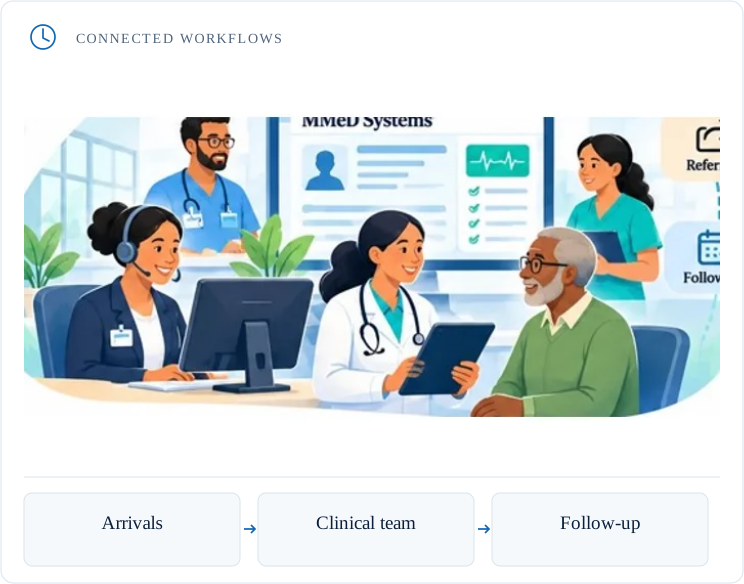
We map the visit from arrival through disposition, including patient identification, queue status, clinical assessments, orders, results, and discharge instructions. The evaluation also considers how completed services connect with charge capture and payment processes.
The aim is a clear view of what has happened, what remains outstanding, and who is responsible next.
A WORKFLOW TO PLAN AROUND
Bring clarity to a changing patient queue.
A proposed journey for discussion. Configuration, available capabilities, integrations, and production readiness require evaluation.
Select a step to see what it covers and how we would plan it with your team.
Arrival
Show where a visit begins and how responsibility passes from reception to the clinical team. We would define the arrival status, the information needed at that point, and who receives the next task.
Registration
Connect patient identification and registration information to the encounter. We would review how your team checks an existing record, creates a new one when needed, and passes the visit to the appropriate staff.
Clinical assessment
Connect the clinical assessment with the provider encounter. We would define the documentation needed, staff permissions, and how relevant information passes to the next team member according to your clinic’s policies.
Provider encounter
Bring the assessment, consultation notes, and next actions together for professional review. We would map documentation responsibilities and how orders, results, and follow-up tasks connect to that visit.
Diagnostics or treatment documentation
Keep diagnostic requests, results, and treatment documentation connected to the encounter. We would assess any required interfaces, review steps, and how completed services reach charge capture, without assuming an existing integration.
Discharge
Bring completed documentation, remaining actions, and discharge information into a clear handoff. We would plan who reviews the visit, records its outcome, and gives the patient the agreed information.
Follow-up instructions
Make the instructions and follow-up responsibilities clear after the visit. We would map who prepares the information, how referrals or next appointments are documented, and how outstanding tasks are reviewed.
A QUESTION WORTH ASKING
Can scheduled appointments and walk-ins be considered together?
Yes. We would review how both encounter types should appear in the clinic’s workflow, including status changes, staff responsibilities, and exceptions. Specific functionality would be confirmed during evaluation.
This page describes MMeD’s design and implementation approach, not a claim that every workflow is available in production.
YOUR ORGANIZATION. YOUR PROPOSAL.
A scope—and a price—built around your organization.
Your requirements determine the proposal. We review the services you provide, the workflows you want to improve, your existing systems, and the implementation and support you need.
Your itemized proposal should explain the agreed software scope, configuration, integrations, onboarding, training, and support. It should also distinguish one-time charges, recurring costs, optional services, and relevant third-party dependencies.
Please share general business requirements only. Do not include patient records or sensitive clinical information in an initial inquiry.