Behavioral Health and Recovery Services
Community Behavioral Health Organizations
Connect multidisciplinary services without losing individual responsibilities.
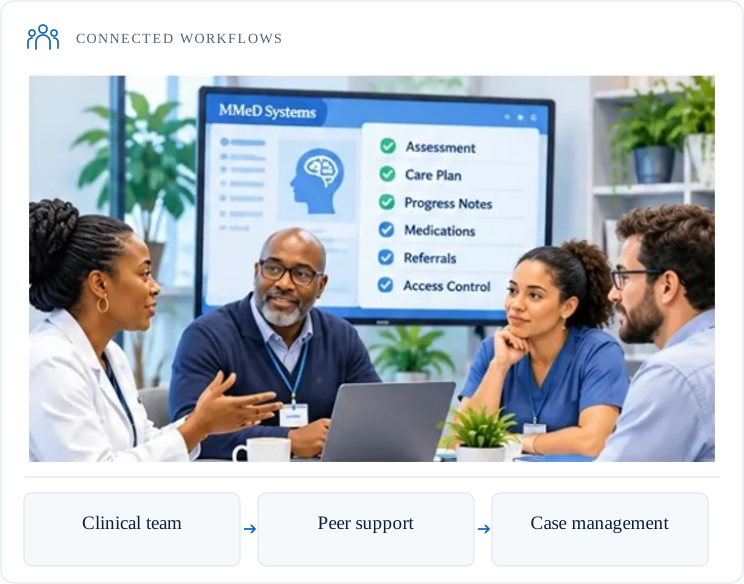
Community behavioral health organizations may bring clinicians, nurses, prescribers, peer specialists, case managers, and support teams into the same care journey. MMeD Systems considers how those roles coordinate information and actions.
WORKING WITH MMED
How MMeD works
with your team.
We begin with service intake, assessments, care planning, encounter documentation, referrals, team tasks, and transitions between programs.
The evaluation also considers how program structure affects permissions, reporting, appointment coordination, and the information each team member needs to perform their work.
A WORKFLOW TO PLAN AROUND
Connect multidisciplinary services without losing individual responsibilities.
A proposed journey for discussion. Configuration, available capabilities, integrations, and production readiness require evaluation.
- Referral
- Intake
- Multidisciplinary assessment
- Care plan
- Assigned services and tasks
- Review
- Transition or continued support
A QUESTION WORTH ASKING
Can different programs have different workflows?
That should be addressed explicitly during planning. Some information may need to be shared, while documentation, staff responsibilities, and access requirements may differ by service or program.
This page describes MMeD’s design and implementation approach, not a claim that every workflow is available in production.
YOUR ORGANIZATION. YOUR PROPOSAL.
A scope—and a price—built around your organization.
Your requirements determine the proposal. We review the services you provide, the workflows you want to improve, your existing systems, and the implementation and support you need.
Your itemized proposal should explain the agreed software scope, configuration, integrations, onboarding, training, and support. It should also distinguish one-time charges, recurring costs, optional services, and relevant third-party dependencies.
Please share general business requirements only. Do not include patient records or sensitive clinical information in an initial inquiry.